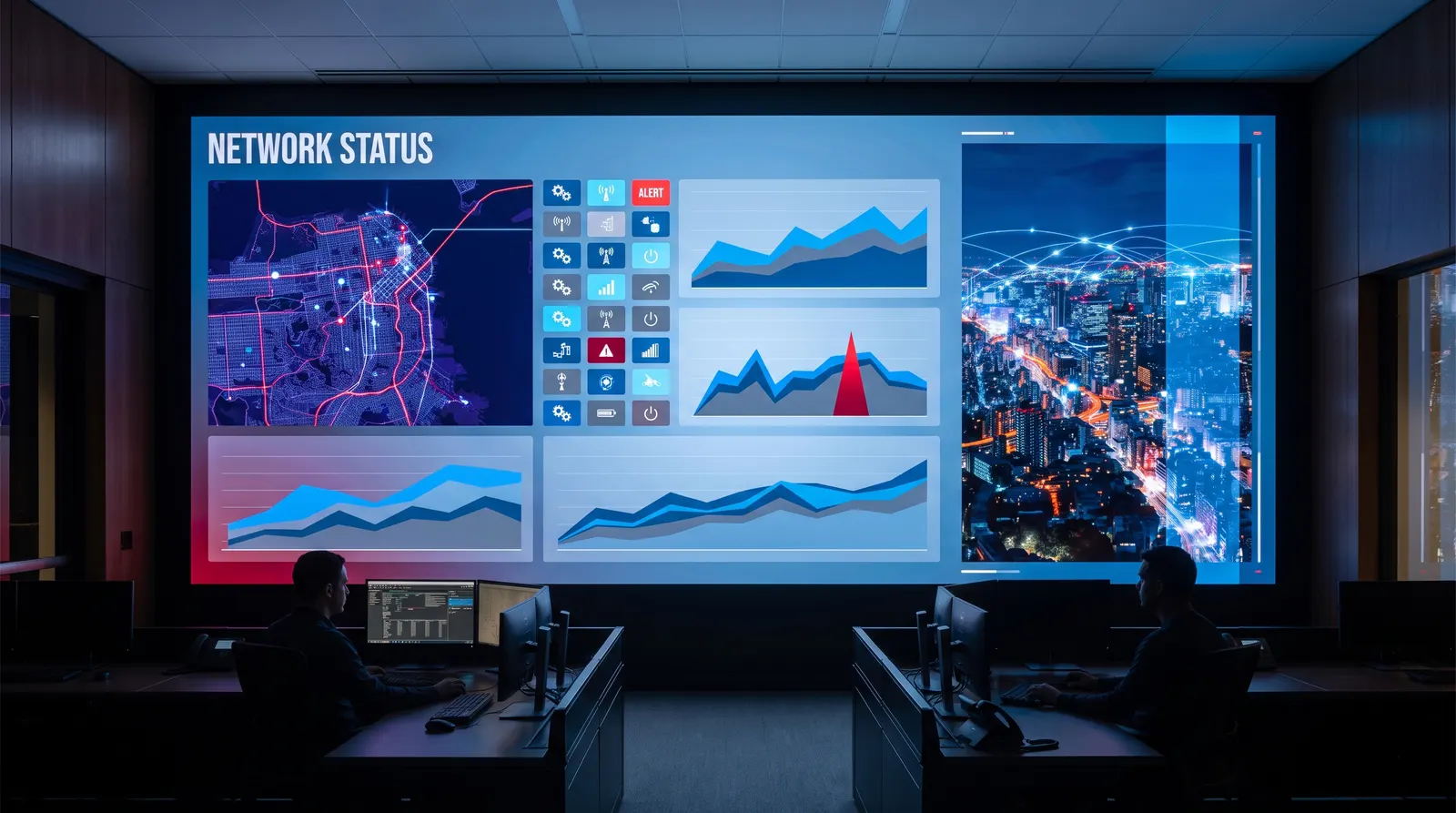
For fifteen years this comparison had one line in it. LCD video walls have bezels; LED walls do not; if the client cares about the seams, sell LED. Everything else was price.
That argument is over — LED won it — and it has been replaced by a more awkward one. Direct-view LED is now available at every size and pitch an indoor job could want, so the question is no longer whether it can do the job. It is whether the job justifies what it costs to own. That is a harder conversation, and it is the one your client is actually having internally.
What actually changed
Three things, all commercial rather than optical.
Fine pitch got cheap enough to be normal. A 1.5 mm wall was an executive-briefing- centre item a decade ago. It is now a meeting-room item. The pitches that matter commercially sit between 0.7 and 1.8 mm, and there is real competition at every step of that range.
The all-in-one panel took the bottom of the market. For a single screen up to about 220 inches, a pre-assembled LED slab now competes directly with a 2×2 or 3×3 LCD array on installed cost, and beats it on everything else. That used to be LCD’s safest ground. We wrote about that separately.
LCD stopped improving. Bezels reached about 0.44 mm combined and stopped. Panel makers moved their attention and their capital elsewhere. A tiled LCD wall you specify today is essentially the product you could have specified in 2020.
The honest comparison
Figures below are typical ranges for commercially available product, not any manufacturer’s catalogue. Use them to frame a conversation, then quote from real data sheets.
| Tiled LCD | Direct-view LED | |
|---|---|---|
| Seams | 0.44–3.5 mm bezel, always visible | None |
| Effective pitch | ~0.5 mm | 0.6–10.4 mm |
| Brightness | 500–800 nits | 600–1 500 indoor, 5 000–10 000 outdoor |
| Shape | Rectangles, in whole panels | Any shape, curve, corner or column |
| Outdoor | Specialist enclosures only | Standard product |
| Power | Flat, backlight always on | Varies with content, ~⅓ of max typical |
| Depth | ~130 mm plus mount | 40–110 mm, often wall-flush |
| Rated life | ~50 000 h to half brightness | ~100 000 h to half brightness |
| Repair | Swap a whole panel | Swap a module, or a single package |
| Hardware cost | Lower, particularly under 4 panels | Higher, and dominated by pitch |
Read that table and LED wins nine rows out of ten. Which is why the last row keeps deals honest.
Where LCD is still the right answer
Not many places, but they are real, and a reseller who names them is more credible than one who pretends they do not exist.
- Dense data, read from close up. A trading desk or a NOC where operators sit two metres away reading small type. LCD’s effective pitch is around 0.5 mm; you can buy LED that fine, but the price step is severe and the client may be paying it to remove a bezel they had stopped noticing.
- Small arrays on a tight budget. A 2×2 in a reception where nobody has ever asked about the seams. LED will cost more, and the extra buys something the client has not asked for.
- Estates already standardised on LCD, with spares, mounts, training and a service contract already in place. Introducing a second technology for one room has a cost that never appears on the quotation.
- Static content in a bright room. Both technologies suffer image retention, but a fixed layout on a wall running 24/7 is a maintenance conversation you need to have either way.
Where LED is not really a choice
- Anything a photographer or a camera will point at — the seam is the first thing the lens finds.
- Anything outdoors, or behind glass in daylight, where you need thousands of nits.
- Anything that is not a rectangle: a curve, a column, a corner wrap, a ribbon over a doorway.
- Anything above roughly 5 metres wide, where an LCD array becomes a grid rather than a screen.
- Anything the client calls a “statement”. That word means the screen is the point.
Making the total-cost argument properly
The strongest LED case is rarely the hardware price, so do not fight there. It is the ten-year number, and it has four parts.
Life. Roughly 100 000 hours to half brightness against roughly 50 000. At 12 hours a day that is about 22 years against 11 — so a ten-year plan buys the LCD wall once and replaces it once, or buys the LED wall once.
Power. An LCD backlight draws what it draws regardless of content. LED draws roughly a third of its maximum on normal content, which is why content design has a running cost. On a dark-field layout LED is often cheaper to run despite the bigger headline figure.
Repair. A failed LCD panel means one whole panel, matched for colour, and a visible difference if you cannot match it. A failed LED module is a smaller part and a shorter visit, and on a front-serviceable cabinet it does not need access behind the wall — which on a wall built into joinery is the difference between an hour and a day.
Build. An LED wall usually needs less depth, which occasionally saves a wall being moved. That is a builder’s-cost saving that belongs on your side of the ledger.
The four questions that settle it
- How close does anyone actually stand? Under 2 m with dense data, LCD stays in the conversation. Beyond 3 m, the bezels start being the only thing anyone remembers.
- Will it be photographed? If yes, LED, and check the refresh rate is at least 1 920 Hz — 3 840 Hz if it will be broadcast.
- Is it a rectangle? If not, the decision has already been made.
- Who pays the electricity, and for how long? If the client owns the building and the ten-year view, the argument is yours. If a tenant is fitting out on a five-year lease, it is not, and pushing it will cost you credibility.
Size both, price both, and let the client choose with the numbers in front of them. The one you lose that way you were never going to win — and the one you win, you win properly.